Can I do anything to change the position of a breech baby?
In the first two trimesters the fetus is so small that it moves freely, but after the seventh month of pregnancy, when its possibilities of movement become more limited due to the increase in length and volume, it usually turns around and puts the head in place in the uterus. This way, it leaves more space in the upper part of the placenta that is wider, in order to position the legs and the rest of the body more comfortably. This position, in addition, facilitates the delivery.
Below you have an index with all the points that we will discuss in this article.
Index
Can I do something to change the position of a breech baby?But in 2-3% of deliveries, the baby is placed breech or breech position, in this position the baby is sitting on the cervix and legs crossed, offering first the buttocks at the time of delivery. It is considered incomplete if it is with the legs stretched with the feet toward the upper part of the uterus.
Position of the babyWhy do you have a breech?
- It is common in premature births because you have not had time to turn around.
- Sometimes the baby spreads his legs instead of folding them and that makes his mobility difficult.
- A knot in the umbilical cord can prevent it from turning around.
- The presence of a placenta previa.
- If the mother has myomas or uterine malformations.
In these cases in which the baby comes from breech, the doctor will tell you, most likely, that the delivery will be by cesarean section.
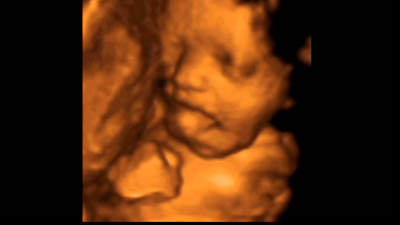
Can I do something to change the position of the baby naturally?
The answer is yes, you have to be positive and believe in the natural wisdom of the baby and your body. And with a bit of luck and dedication, maybe we'll get it back naturally. Some exercises and tips that you can practice are:
- Get on all fours. Lower your head and shoulders to the floor and lift your buttocks up. Hold the posture for 20 minutes twice a day.
- Lie on your back and put your legs on an armchair or chair so that your body and legs create a 45 ° angle. If necessary put a cushion on the head to be more comfortable and another under the pelvis to raise it more. Hold the posture for 20 minutes twice a day. Do it on an empty stomach.
- Use sound and light to stimulate your baby to turn and change position. Research shows that babies hear and respond to external stimuli. You can put music and light between your legs so that you feel attracted and want to turn.
- Crawl on soft surfaces five minutes, two or three times a day.
- Practicing yoga: Many of the postures adapted in yoga for pregnant women will help the baby to turn around. In this type of yoga always take into account that the baby has enough space in the abdomen. One of them is the position of the cat, which you can practice two or three times a day.
- It is good to visualize your baby in a cephalic position (head down) and convey that this is how we want it to be. For this it is good to use meditation techniques, make contact with the baby and visualize how it rotates and is placed in the perfect posture.
- Perform abdominal massage: You can perform a massage with cream putting your left hand in the lower abdomen and the right just above, moving them in the direction of clockwise. When the right hand reaches the upper abdomen, the left hand slides over the right and moves down the left side of the belly. Thus, the left hand guides, making a complete circle in a clockwise direction. You can repeat this massage for 10 minutes several times a day.
- Acupuncture, chiropractic and osteopathy can also help the baby find the ideal position.


Comments
Post a Comment